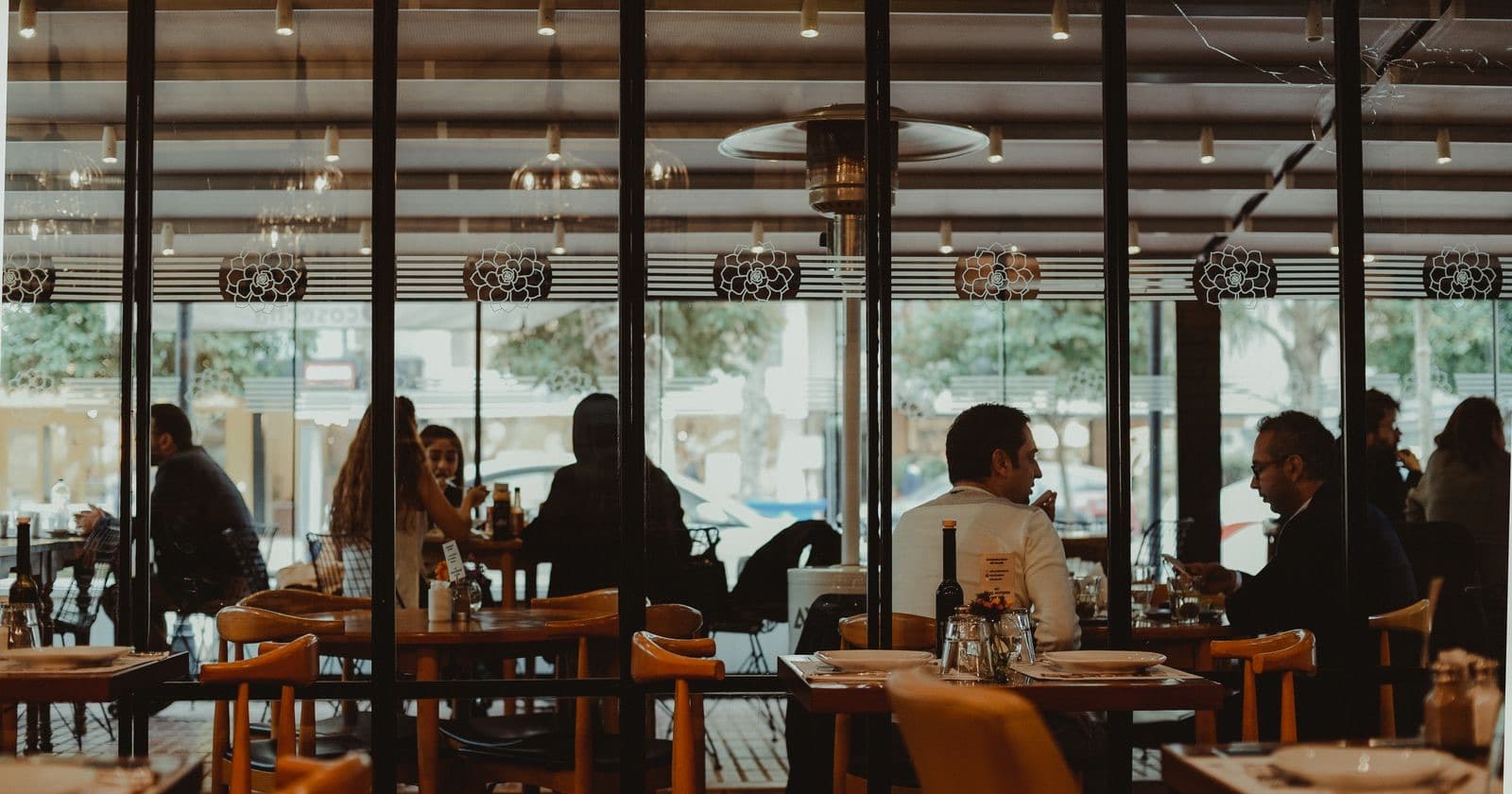
Restaurant Marketing: How UK Restaurants Can Fill More Tables

A one-star Yelp rating rise is linked to a 5-9% revenue lift for independent restaurants (Harvard Business School, 2011). A strategy for reviews and local SEO.
Restaurant marketing is the system that fills tables consistently rather than relying on a good Saturday to carry a quiet Tuesday. Many UK restaurants are good. Tables are still half full on weeknights, weekends swing between packed and empty, and the business isn't operating at capacity because there is no consistent demand generation behind it.
Restaurant marketing covers driving traffic through the door, whether that's walk-ins, reservations, or delivery orders, and building repeat customers so you are not constantly hunting for new diners to replace the ones who never came back. Restaurants with systematic marketing can build more value from repeat visits, while those relying on one-off promotions often spend more acquiring new customers to replace the ones they lose.
What Is the Restaurant Customer Acquisition Pattern?
Four stages drive diners to your restaurant: discovery, trust building, conversion, and retention. Discovery matters most first. A hungry person searches "restaurants near me" or "best Italian in Islington," and your restaurant either shows up or it doesn't. Local search visibility, your Google Maps presence, your review volume, your local SEO, determines discovery before anything else about your food gets a chance to matter.
Trust building comes next. A diner looks at your menu, your photos, your reviews, your hours, and decides whether you're worth visiting. Strong food photography and genuine restaurant ambiance, positive reviews, clear hours, and easy reservation access build that trust. Poor photos and unanswered negative reviews lose diners to a competitor one search result down.
Conversion is where friction kills bookings that discovery and trust already earned. No online reservation link, an unclear address, a complicated ordering process, all of it loses diners to a competitor with an easier path to a table. Retention is a stage many restaurants skip: a diner has a good experience and becomes a regular, and regular diners are usually worth considerably more than one-time guests because they refer others and keep coming back. US restaurant industry data from Toast's Regulars Report 2026 found that moving a guest into a loyalty programme can shift their return rate from a 7% baseline to nearly 30%, roughly four times, and that up to 50% of order volume can come from just 7% of guests. UK-specific data at this granularity isn't published, but the underlying mechanic, a small base of regulars driving a disproportionate share of revenue, holds regardless of market: it's why a loyalty and email programme earns its keep even at modest diner volumes.
How Do Winning Restaurants Market Effectively?
Optimise for local discovery. Your Google Business Profile is your digital storefront. Optimise it completely: high-quality food photos, clear hours, a full address with a direction link, visible reservation and ordering links, weekly updates at minimum, and review responses within 24 hours. Diners should find you immediately and get everything they need to decide to visit.
Build social proof through reviews. A landmark Harvard Business School study of Yelp-rated restaurants found that a one-star increase in rating is associated with a 5-9% increase in revenue, an effect driven specifically by independent restaurants rather than chains (Michael Luca, 'Reviews, Reputation, and Revenue: The Case of Yelp.com,' Harvard Business School, 2011). Reviews aren't just decoration on your profile, they're actively deciding how many people walk through the door. Implement systematic review generation: post-visit requests by email or text, a QR code on the table, staff trained to ask verbally, and a response to every review, especially negative ones, within 24 hours. Professional responses to complaints build trust with prospective customers who are reading the thread, not just the original reviewer.
Invest in real food and restaurant photography. Professional or well-composed photos of your best dishes, your ambiance, and your team tend to drive more enquiries than restaurants with no imagery at all. Phone photos are acceptable if well-composed and well-lit; stock photos tend to build less trust than real ones, because diners can tell. Update your photos regularly as menus change seasonally.
Make reservations and ordering easy. OpenTable, SevenRooms or your own booking system, with links visible on your website and your Google profile. The same applies to ordering, whether through a delivery platform or your own system. Every extra step between intent and booking loses diners to a competitor with fewer steps. Mobile-friendly reservation and ordering pages are non-negotiable, since much of this discovery happens on a phone.
Email your past customers regularly. Monthly or biweekly emails covering new menu items, offers, events, and loyalty rewards drive repeat visits at a fraction of the cost of acquiring a new customer. Past customers are usually cheaper to bring back than new customers are to acquire from scratch.
Run seasonal campaigns and weeknight promotions. Spring and summer patio season, autumn comfort food, winter and New Year menus, all create urgency during specific windows. Weeknight promotions, a set night for a specific offer, build habit: diners plan to visit on a specific night weekly, and habit drives more revenue over a year than sporadic one-off promotions ever do.
What Does a Restaurant Marketing Programme Involve?
Take an illustrative scenario (not a client result): a casual dining restaurant that is busy at weekends and half empty on weeknights, wanting to fill the quiet nights without discounting trade it already has. The changes are not complicated: Google Business Profile optimisation with high-quality photography and a prominent reservation link, a systematic review generation process, a monthly email programme to a past customer database including a simple loyalty offer, Instagram stories showing daily specials and kitchen activity, and three specific weeknight promotions, a discounted taco night, a wine night, and a happy hour with appetiser specials.
Each part of that combination addresses a different gap, which is why it is run as a set rather than one piece at a time. The profile and the reviews win the search that happens before anyone picks a restaurant. The email programme and the loyalty offer bring back people who have already been in once, which is where the repeat customer rate moves. The weeknight promotions give a reason to come on a Tuesday rather than a Saturday, so weeknight occupancy can rise without touching the weekend trade. Easier ordering and better local visibility can lift delivery volume alongside it. Much of the gain in customer lifetime value can come from visit frequency rather than higher spend per visit, which is why retention work often pays back more reliably than upselling.
What Are the Most Common Restaurant Marketing Mistakes?
Marketing only when business is slow. Heavy marketing during quiet periods and silence when busy is backwards. Consistent marketing builds habit; diners establish where they like to go. Sporadic marketing produces sporadic customers.
Not requesting reviews systematically. Review signals are an increasingly important local search ranking factor, not just a trust signal for diners browsing your profile (Whitespark, 2026 Local Search Ranking Factors report), but recency and quality of reviews matter as much as raw count, so a steady flow of new reviews beats a large stagnant pile from years ago, and ranking is what gets the click. A post-visit request by email or text, a QR code on the table, and a staff verbal ask together usually produce more reviews each month than waiting for them to arrive unprompted.
Neglecting email marketing. No past customer database and no email system means missing one of the cheapest, highest-return channels available. A simple monthly or biweekly email with new items and offers closes this gap quickly.
Poor food photography. No photos, or poor-quality ones, and diners cannot visualise what they're ordering. They go to the competitor with better photos instead. Well-composed phone photos, updated regularly, are enough.
Want a second opinion on your marketing?
Book a call to talk through where you may be losing leads. No obligation.
Book a call →Making reservations difficult. A reservation system that's hard to find or clunky to use sends diners to book with a competitor instead. Easy reservation access drives volume that a beautiful menu alone cannot.
How Do You Build a Loyalty Programme That Actually Gets Used?
Many restaurant loyalty programmes fail not because customers dislike rewards, but because the mechanics are too complicated or too slow to pay off. A punch card requiring ten visits before any reward, or an app requiring a separate download and login, loses many diners before they ever redeem anything. In general, the loyalty programmes that see repeat engagement are the simplest: tied to an email or phone number the restaurant already captures at booking or checkout, with the first reward achievable within two or three visits so customers feel momentum early.
A workable structure for an independent restaurant: capture contact details at the point of sale or reservation, track visits or spend against that record automatically through your POS system, and trigger an automatic reward at a low visit threshold, then a bigger reward at a higher threshold to encourage sustained loyalty. Communicate progress through the same email marketing you already use for specials; a quick note that a customer is one visit from a reward is often enough to bring them back on a slow Tuesday. Get the basics right first, consistently capturing emails or phone numbers at every reservation and checkout, before investing in a formal rewards structure. Without that foundation, a loyalty programme has no one to reward.
How Should You Handle Slow Periods Beyond Discounting?
Discounting a slow Tuesday is the easiest lever to pull, but it is not the only one, and over-reliance on price cuts erodes margin and trains regulars to only show up when there's a deal. Non-discount levers that fill slow periods without damaging perceived value include curated experiences, a themed tasting menu one night a week, private hire promotion for small groups during off-peak hours, and partnerships with nearby businesses, a lunch deal for staff of a local office in exchange for cross-promotion.
Changing what you're known for on a specific night, rather than discounting the same menu, is another underused lever. A weekly chef's table concept or a rotating guest menu gives diners a reason to visit that isn't purely price-driven, and it generates the kind of photo and social content that markets itself. Restaurants that diversify beyond discounting tend to build a more resilient weeknight customer base, one that returns for the experience rather than the price cut.
Frequently Asked Questions
How important are reviews compared to other factors in restaurant marketing?
Very important. A landmark Harvard Business School study found that a one-star increase in Yelp rating is associated with a 5-9% increase in revenue for independent restaurants (Michael Luca, 'Reviews, Reputation, and Revenue: The Case of Yelp.com,' Harvard Business School, 2011), and reviews directly influence dining decisions long before a booking is made. Systematic review generation is one of the highest-value places to start.
Should we offer discounts to boost traffic?
Strategically, yes, but not permanently. Permanent discounts train customers to expect low prices, which damages margins over time. Seasonal or periodic promotions create urgency without that long-term cost. Early-week discounts, Tuesday to Thursday, incentivise visits during slow periods without touching weekend pricing.
How often should we email past customers?
Monthly or biweekly is the sweet spot. More frequent starts to feel like spam. Less frequent loses top-of-mind awareness entirely. A monthly email featuring new items and offers is a reliable standard to start from.
What's the best promotion for winning first-time customers?
A first-visit offer can get someone through the door, but the experience has to earn the return visit. A discount customer who never comes back is a wasted acquisition cost. Focus on experience quality first; the offer is only the door-opener.
How much should we spend on local ads versus organic marketing?
There is no fixed split. Start with free organic channels and use local ads to amplify what already works. Google Business Profile optimisation and email marketing are largely free and compound over time, so reduce ad spend as organic channels mature.
To discuss a restaurant marketing strategy for your business, see how our SEO agency approach works for hospitality, explore social media management for restaurants, or contact the Blackstone Media team.

Written by Ash Aziz, Founder, Blackstone Media
Recent Posts

Popular Tags
Keep Reading
Related Articles
Your Turn
Want to talk it through?
Book a call with our team to talk through your goals. No obligation.
Book a call →